Most visitors meet Bali as a beach, a temple and a sunset. Behind them sit two thousand years of bronze casters, Javanese conquerors, rival kingdoms, a colonial war that ended in royal processions walking into gunfire, an eruption and a massacre. Knowing that story changes what you see in every temple courtyard and palace gate.
What is the short history of Bali?
Bali was settled in prehistory, became a Hindu-Buddhist kingdom by the 10th century, and fell under the Javanese empire of Majapahit in the 14th. For the next five centuries it was ruled by Balinese royal houses, until the Dutch conquered the island between 1849 and 1908. It became part of independent Indonesia after 1945, and from the 1970s it grew into one of Asia's largest tourist destinations.
What makes Bali unusual is continuity. When Islam spread across Java from the 15th century, Bali kept its Hindu courts, priests and temple calendar. That is why the island today is around 86 to 87 per cent Hindu in a country where Hindus are under 2 per cent of the population, and why a 500-year-old temple can still be the busiest place in a village on a festival day.
| Period | What happened | Where to see it today |
|---|---|---|
| c. 2,000 years ago | Metal-age burials and bronze casting | Gilimanuk museum; Pura Penataran Sasih, Pejeng |
| 914 | Sri Kesari Warmadewa's pillar inscription | Pura Blanjong, Sanur |
| 1343 | Majapahit conquers Bali under Gajah Mada | Bedulu and Pejeng area, near Ubud |
| 16th century | Gelgel court at its height; priest Nirartha | Gelgel village; Uluwatu and Tanah Lot temples |
| 1686 | Klungkung kingdom founded at Semarapura | Kertha Gosa, Klungkung |
| 1849 | Dutch take Buleleng and Jembrana | Singaraja waterfront; Jagaraga |
| 1906 and 1908 | Puputan of Badung and Klungkung | Puputan Square, Denpasar; Klungkung monument |
| 1946 | Ngurah Rai's last stand at Marga | Margarana memorial, Tabanan |
| 1963 | Agung erupts during Eka Dasa Rudra | Besakih |
| 2002 | Kuta bombings | Memorial on Jalan Legian, Kuta |
Who were the first people on Bali?
The clearest early evidence comes from Gilimanuk at Bali's western tip, where archaeologist R.P. Soejono excavated a large prehistoric cemetery. The burials are generally dated to around the start of the first millennium AD and include skeletons, pottery grave goods, bronze ornaments, metal spearheads and, for high-status people, carved stone sarcophagi.
Stone sarcophagi have also turned up across the island's interior, and several are displayed at the Bali Museum in Denpasar and at the small prehistory museum in Gilimanuk. They show that Bali already had a society with ranks, rituals for the dead and links to the wider bronze-working world of Southeast Asia long before any Indian influence arrived.
The Moon of Pejeng
The most famous object of this age hangs in a tall pavilion at Pura Penataran Sasih in Pejeng, a few kilometres east of Ubud. The "Moon of Pejeng" is a bronze kettledrum about 186 cm high with a face 160 cm across, described as the largest single-cast drum of its kind in the world. It belongs to the Dong Son tradition that spread from northern Vietnam more than 2,000 years ago. Balinese legend says it is a fallen moon. It was first described in a European book by the naturalist G.E. Rumphius in 1705.
When did Hinduism and Buddhism come to Bali?
Indian religious ideas reached Bali through trade and through Java during the first millennium AD, and by the 10th century the island had kings who wrote in Sanskrit and Old Balinese. The turning point for historians is a stone pillar in Sanur.
The Belanjong (Blanjong) pillar stands in a small enclosure at Pura Blanjong in southern Sanur, close to what was once a harbour. Its inscription is dated to 4 February 914 and names Sri Kesari Warmadewa, regarded as the first king of the Warmadewa dynasty, and refers to his military campaigns. It is written in Sanskrit on one side and Old Balinese on the other, and is the earliest known Balinese inscription in which a king records his own name. Most visitors walk past the temple on the way to the beach; it takes ten minutes to see.
The Warmadewa kings kept close ties with Java. The best-known example is King Udayana, whose son Airlangga went on to rule in East Java in the 11th century. The rock-cut monuments of this era are the ones travellers still visit: Goa Gajah, the "Elephant Cave" near Bedulu, and the royal tombs carved into the cliffs at Gunung Kawi near Tampaksiring.
How did Majapahit change Bali?
In 1343 the East Javanese empire of Majapahit, led by its chief minister Gajah Mada, conquered Bali and defeated the last independent king, whose court lay at Bedulu. Bali became a vassal of Java, and a new Javanese-descended dynasty was installed, first at Samprangan and later at Gelgel near today's Klungkung.
Majapahit's legacy is everywhere in Bali. The caste-like system of noble titles, the court literature, much of the ritual calendar and the idea that Bali's royal houses descend from Java all date from this period. Villages that kept older, pre-Majapahit customs, such as Tenganan in the east and Trunyan on Lake Batur, are known as Bali Aga, the "original Balinese", and are still visited for their distinct traditions.
The Gelgel golden age and the priest Nirartha
Balinese chronicles remember the 16th century as the high point of Gelgel, under a king usually called Dalem Baturenggong (also spelled Waturenggong). The dates in these chronicles are traditional rather than precise. In this era the Javanese priest Dang Hyang Nirartha arrived, sent from Java in the late 15th century according to tradition, and became the most influential reformer of Balinese Hinduism. He is credited with introducing the padmasana, the empty stone throne for the supreme god found in almost every Balinese temple, and with founding or inspiring sea temples such as Uluwatu and Tanah Lot.
As Majapahit itself declined and Java's courts converted to Islam, Balinese nobles and priests saw their island as the keeper of the old Hindu-Javanese culture. That self-image still shapes Balinese identity.
When did Europeans first reach Bali?
The first Dutch fleet, under Cornelis de Houtman, reached Bali in February 1597. The sailors met the king, traded for a little pepper, and two crew members chose to stay behind. The meeting was friendly, and for the next 250 years Europeans left Bali largely alone because it had no spices worth fighting for.
Instead, Bali's main export to the wider world in that era was people. Balinese courts sold war captives and debtors as slaves to Dutch-controlled Batavia and other ports, a trade that was an important source of royal income until the 19th century.
Gelgel splits into nine kingdoms
Gelgel lost territory in Lombok and Sumbawa to Makassar in the early 17th century and then fell into internal conflict after 1651. In 1686 a new dynasty under Dewa Agung Jambe set up the kingdom of Klungkung at Semarapura. Its rulers kept a ceremonial seniority, but real power was spread between rival courts. By the 19th century Bali was usually described as nine kingdoms: Klungkung, Karangasem, Buleleng, Jembrana, Tabanan, Badung, Gianyar, Bangli and Mengwi, though Mengwi was carved up by its neighbours in 1891. Today's regencies follow those old borders closely.
The best surviving monument of this court world is the Kertha Gosa, the floating pavilion and hall of justice in Klungkung's Taman Gili, with painted ceilings in the classical Kamasan style.
How did the Dutch conquer Bali?
The Dutch took Bali in two stages: the north in 1846 to 1849, and the south between 1906 and 1908. Their pretext both times was the Balinese custom of claiming the cargo of ships wrecked on their shores, which the Dutch refused to accept.
The first two expeditions, in 1846 and 1848, failed. In 1848 Balinese forces under I Gusti Ketut Jelantik, chief minister of Buleleng, defeated the Dutch at the fortified village of Jagaraga. A larger expedition in 1849 took Jagaraga in April after heavy fighting. With help from the ruler of Lombok, the Dutch then broke the alliance of Buleleng and Karangasem, and a treaty brokered in part by the Danish trader Mads Lange left Buleleng and Jembrana under Dutch control. The north was governed from Singaraja, which remained the colonial capital of Bali.
What was the puputan?
A puputan, from a Balinese word meaning "ending", is a ritual fight to the death by a ruler and his court rather than surrender. Two of them ended Balinese independence in the south and became the most remembered events in the island's history.
In September 1906, after a dispute over the looting of a wrecked Chinese schooner, a Dutch force landed at Sanur on 14 September and marched on Denpasar. On 20 September the Raja of Badung, dressed in white and carried in a palanquin, led his family, priests and followers out of the burning palace towards the Dutch guns. Hundreds died; contemporary accounts put the dead at over a thousand across the day, including a second puputan at the Pemecutan palace that afternoon. The Raja of Tabanan surrendered soon after and took his own life in captivity.
In April 1908, after unrest over a Dutch opium monopoly, the Dutch bombarded Klungkung. On 28 April the king, Dewa Agung Jambe, walked out with his followers and was shot; his wives and court followed. The Klungkung puputan ended the last of Bali's independent royal courts.
The 1906 events took place where Puputan Square (Lapangan Puputan Badung) now lies in central Denpasar, with a bronze monument to the families who died. In Klungkung, the Puputan monument stands opposite the Kertha Gosa.
How did Bali become a tourist destination?
Tourism began under the Dutch, in the 1920s and 1930s. The shock of the puputan had damaged the colonial government's reputation, and officials now promoted Bali as a "living museum" of Hindu culture to be preserved rather than modernised. Regular steamship services from Java began in the 1920s, and the Dutch shipping line KPM opened the Bali Hotel in Denpasar in 1928. The building still operates as the Inna Bali Heritage Hotel.
Images built the image. Gregor Krause, a German doctor posted to Bangli from 1912 to 1914, published hundreds of his photographs in the book Bali in 1920. The German painter and musician Walter Spies settled in Bali in 1927 and made his house at Campuan, Ubud, a stopping point for writers, film-makers and anthropologists. The Mexican artist Miguel Covarrubias published Island of Bali in 1937, still one of the best introductions ever written.
In 1936 Spies, the Dutch painter Rudolf Bonnet, the Balinese artist I Gusti Nyoman Lempad and Ubud's prince Cokorda Gde Agung Sukawati founded the Pita Maha artists' association, which helped create the Ubud painting style. Spies also worked with the dancer Wayan Limbak in the 1930s to turn the chant of a trance ritual into the Ramayana-based kecak performance that tourists now watch at Uluwatu. Ubud's Museum Puri Lukisan, built to Bonnet's design from 1954, holds work from this period.
What happened in Bali during the war and independence?
Japanese troops landed on Bali on 18 February 1942 to capture the airfield south of Denpasar, and the island was occupied until 1945. When the Dutch returned after Indonesia declared independence, Balinese fighters resisted.
The defining moment came on 20 November 1946 at Marga in Tabanan. Lieutenant Colonel I Gusti Ngurah Rai and his Ciung Wanara battalion were surrounded by Dutch forces and fought to the last man; around 96 Indonesian fighters died. The battle is remembered as the Puputan Margarana, and the memorial park at Marga is one of the most moving historical sites on the island. Bali's airport and its main bypass road carry Ngurah Rai's name.
The Netherlands transferred sovereignty to Indonesia at the end of 1949. On 14 August 1958, a national law created the province of Bali, with Singaraja as its capital. The seat of government moved to Denpasar between 1958 and 1960, closer to the populous south.
What happened in Bali in 1963 and 1965?
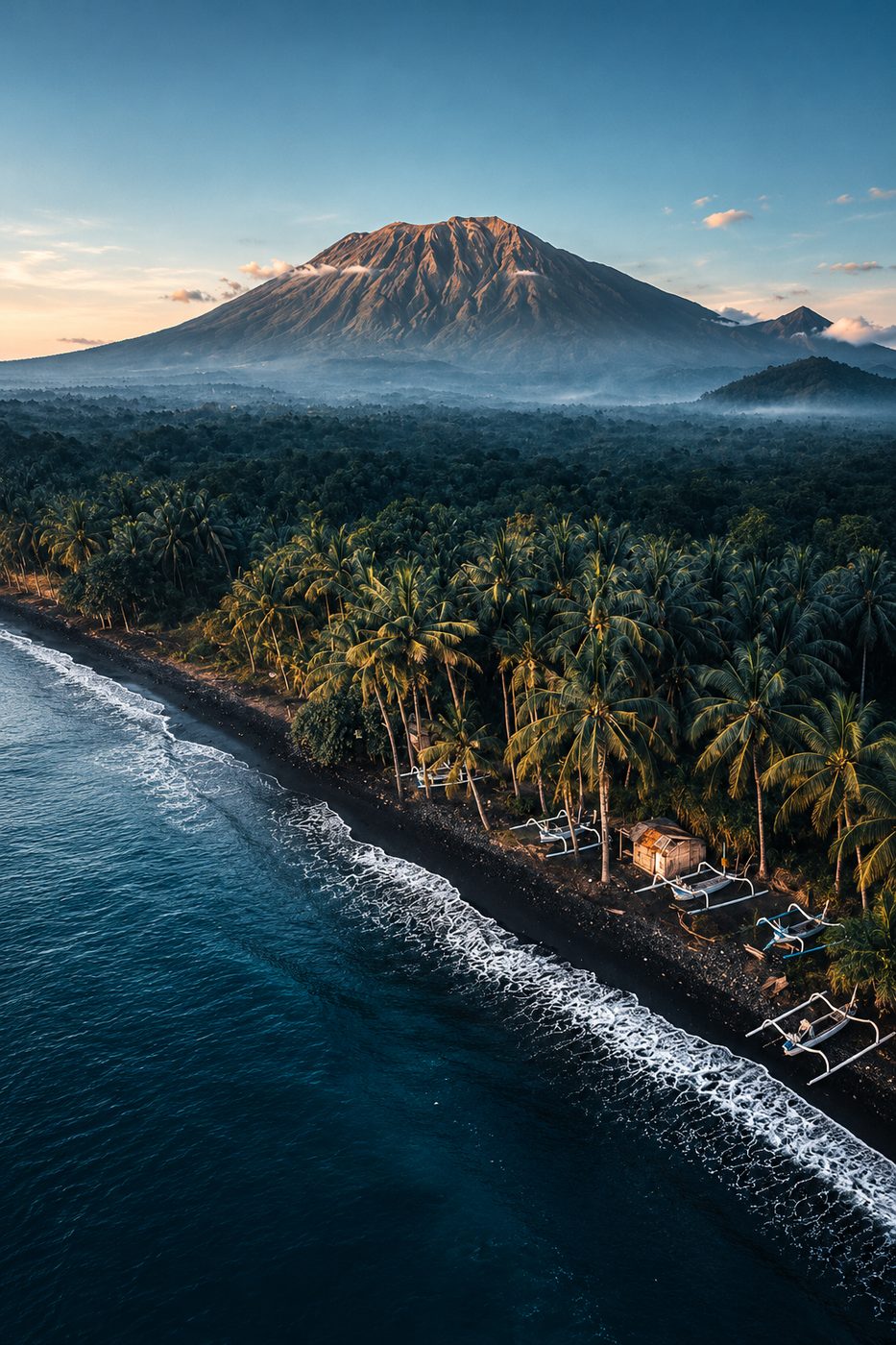
The early 1960s were the hardest years in modern Balinese history. In 1963 Mount Agung, Bali's highest volcano at 3,031 m, erupted for the first time in about a century, just as the island was preparing Eka Dasa Rudra, a purification ceremony at Besakih meant to be held roughly once every hundred years. The main eruption on 17 March 1963 sent pyroclastic flows down the mountain; an estimated 1,100 to 1,500 people died, with more killed by lahars and a second eruption in May. Besakih itself was spared. The ceremony was performed again, in full, in 1979.
Two years later came the violence that followed the failed coup of 30 September 1965 in Jakarta. Across Indonesia, the army and allied groups killed people accused of links to the Communist Party. In Bali the killings peaked in December 1965 and early 1966; historians estimate around 80,000 people died on the island in a few months. The subject was officially silenced for decades, and many Balinese families still do not speak of it openly. Geoffrey Robinson's The Dark Side of Paradise is the standard history in English.
How did mass tourism change Bali?
Under President Soeharto, tourism became national policy. Bali's airport had begun handling international flights in 1959, and in 1969 the expanded Ngurah Rai International Airport, with a runway built partly on reclaimed land at Kuta, was inaugurated. Jet travel did the rest. Kuta grew from a fishing village into a surf and backpacker strip in the 1970s, and the government built the Nusa Dua resort enclave in the following decades to concentrate large hotels away from village life.
Balinese leaders tried to channel the boom into "cultural tourism", in which ceremonies and arts would both attract visitors and be strengthened by them. Critics note the pressure on land, water and rice terraces; supporters point to the money that now funds temple festivals across the island. Both are visible on any drive from Canggu to Ubud.
Bombings, eruptions and a pandemic
On 12 October 2002, Jemaah Islamiyah bombed Paddy's Pub and the Sari Club on Jalan Legian in Kuta, killing 202 people, including 88 Australians and 38 Indonesians. A second attack on 1 October 2005, in Kuta and on Jimbaran beach, killed 20. A memorial with the names of the victims now stands on the site of the 2002 blasts.
Agung erupted again from November 2017 into 2019, closing the airport for several days and forcing the evacuation of tens of thousands of people. Then the COVID-19 pandemic closed borders in 2020 and international tourism almost stopped. The recovery has been fast: Statistics Indonesia counted 6,948,754 direct foreign arrivals in 2025, a record, with Australia the largest market. Since February 2024 foreign visitors pay a tourist levy of 150,000 rupiah, intended for culture and environmental protection; check the official Love Bali site for current rules.
Where can you see Bali's history today?
Most of the key sites fit into three easy day trips from the south or Ubud.
- Denpasar and Sanur (half a day): the Bali Museum and Puputan Square in central Denpasar, the Inna Bali Heritage Hotel, then the Belanjong pillar at Pura Blanjong in Sanur, where the 1906 Dutch force also came ashore.
- Ubud and the Pakerisan valley (one day): Pura Penataran Sasih and the Moon of Pejeng, Goa Gajah, Gunung Kawi at Tampaksiring, and Museum Puri Lukisan for the Pita Maha painters.
- East Bali (one day): the Kertha Gosa and Puputan monument in Klungkung, Gelgel village just south of it, Besakih on the slopes of Agung, and the Bali Aga village of Tenganan near Candidasa.
- West and north (on the way to other places): the Margarana memorial at Marga in Tabanan, the prehistory museum at Gilimanuk before the Java ferry, and Singaraja's old colonial harbour.
At temples, wear a sarong and sash (most sites lend or rent them), keep your head lower than priests during ceremonies, and do not climb on shrines or walls. Many temples are closed to visitors on the busiest ceremony days, and women who are menstruating are traditionally asked not to enter.
For the full story, from the first settlers and the kingdoms to colonial rule and the rise of mass tourism, our The History of Bali goes deeper than any article can. For the living culture, our Bali culture title explains temples, ceremonies and offerings, and the full guide library covers the island for travellers. If you are combining Bali with its neighbour, read Lombok vs Bali, and for the volcano at the centre of the island's story, see Mount Agung.
Facts checked October 2026. Dates from the Balinese royal chronicles before 1600 are traditional and approximate; historians still debate several of them. Entry rules and the tourist levy can change, so check the official Love Bali portal before you travel.
- Belanjong pillar (Wikipedia, after L.-C. Damais and R. Pringle)
- Moon of Pejeng (Wikipedia)
- The ancient civilization of Gilimanuk (Budaya Bali)
- Balinese Hinduism (Wikipedia)
- Gelgel (Wikipedia)
- Cornelis de Houtman (Wikipedia)
- Dutch intervention in Bali (1849) (Wikipedia)
- Puputan (Wikipedia)
- Puputan Klungkung Monument (Budaya Bali)
- The Construction of Bali's Mystique (BiblioAsia, National Library Board Singapore)
- Rudolf Bonnet and Kecak (Wikipedia)
- Battle of Badung Strait (Wikipedia)
- Battle of Margarana (Wikipedia)
- UU No. 64 Tahun 1958 (Pasal.id)
- Mount Agung (Wikipedia) and Agung's eruption: the wrath of gods? (Oregon State University)
- Ekadasa Rudra ceremony in 1963 and 1979 (Jurnal Historia, Universitas Jember)
- Indonesia's Killing Fields (History Today)
- New book tells Bali airport's humble beginnings (The Jakarta Post)
- 2002 Bali bombings and 2005 Bali bombings (Wikipedia)
- Bali hits a record of 6.95 million foreign tourist arrivals in 2025 (Antara)