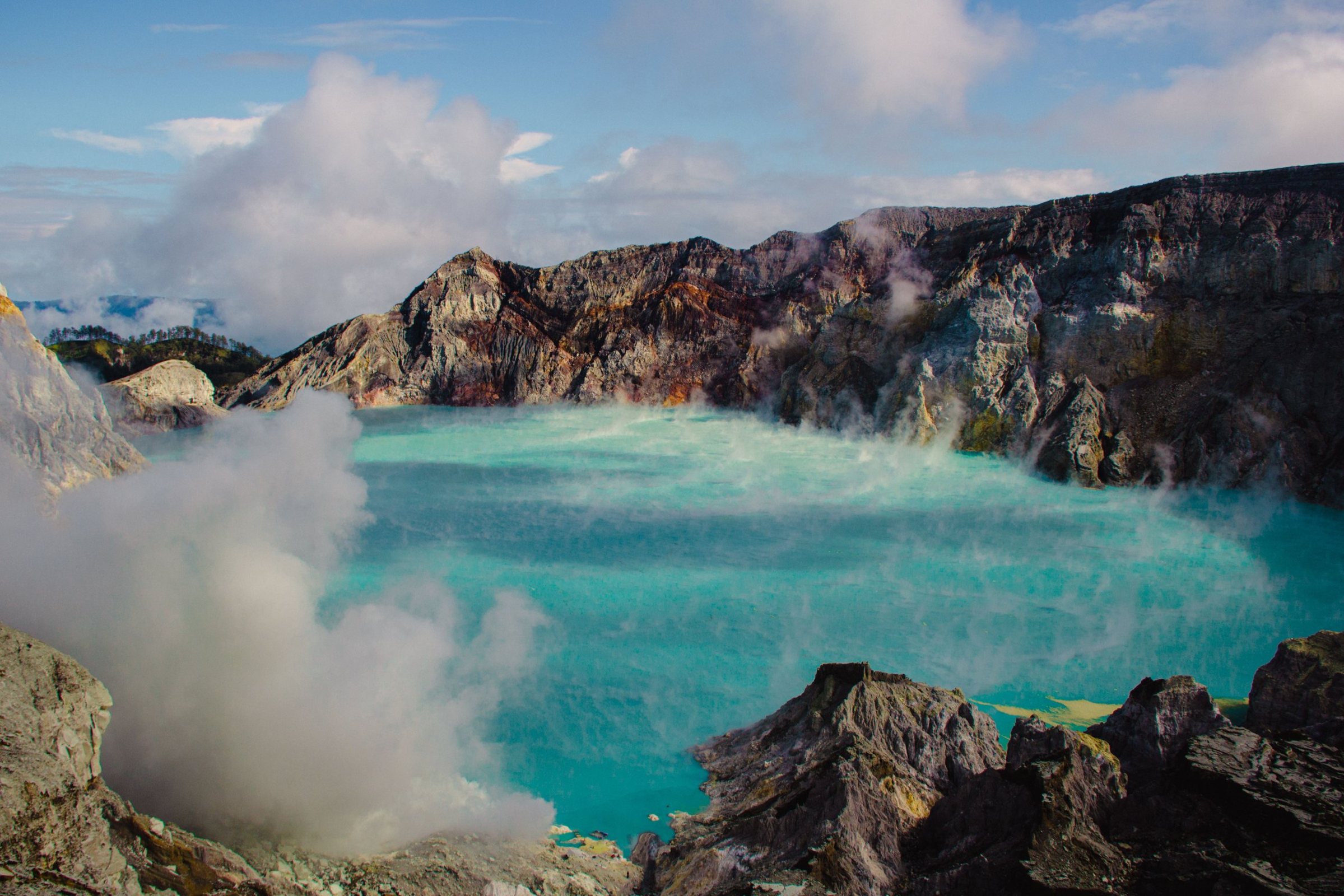
Inside an old caldera in eastern Java, a turquoise lake holds some of the most acidic water on Earth. Before dawn, burning sulphur gases glow blue on the crater floor while miners carry yellow blocks up the walls by hand.
A lake of acid
Ijen is not a single peak but a cluster of small stratovolcanoes standing inside an ancient caldera roughly 20 kilometres wide. Its highest point, Gunung Merapi, reaches 2,769 metres. The active crater, Kawah Ijen, lies lower down and holds a lake that the Smithsonian Global Volcanism Program describes as the largest body of natural hyperacidic brine in the world.
The water is a milky turquoise, warm and close to 200 metres deep. Measurements have recorded a pH near zero. Steam-driven eruptions burst from the lake in 1993, 1994 and 1999, the last recorded eruptions. The lake holds around 30 million cubic metres of water, and in August 2024 its surface measured about 42 °C. Since 1999 the volcano has stirred mainly through gas, heat and periods of raised seismic activity.
The blue fire
The famous blue flames are not lava. Sulphur-rich gases escape from cracks in the crater at high pressure and temperatures of up to 600 °C. When they meet the air, they ignite and burn with an electric blue glow, sometimes in tongues up to five metres high. Some of the gas condenses into liquid sulphur, which can keep burning as it trickles downslope.
The fire burns by day as well, but it is too faint to see in daylight. That is why visitors climb in the dark. Geologists have also noted reports that miners sometimes ignite sulphur themselves, so the size of the display varies from night to night. Sulphur melts at only about 115 °C, which is why it so often runs as a glowing liquid near the hottest vents.
The sulphur miners
On the crater floor, pipes channel volcanic gas from the vents. The sulphur cools inside them and hardens into bright yellow crusts. Miners break it into chunks and load it into baskets to carry out by hand. For many families living at the foot of the volcano, this work is the main source of income.
A typical load weighs 75 to 90 kilograms. The miners carry it up the steep crater wall to the rim, then down the mountain to be weighed, often twice in a day. Few wear proper gas masks. Small medical studies have linked the acidic fumes to eroded teeth and gum disease among the workers. Give them right of way on the narrow path.
Making the climb
Ijen lies within Ijen Geopark, which UNESCO recognised as a Global Geopark in 2023. Most hikes begin at the Paltuding trailhead, about an hour and a half by road from Banyuwangi. Walkers usually set off around one in the morning to reach the crater while it is still dark. The climb to the rim takes roughly two to three hours, depending on pace.
Descending from the rim to the blue fire is a different matter: a rough, rocky path into the crater, often thick with fumes, that takes around 45 minutes. Hire a licensed guide and wear a gas mask with proper filters. Bring warm layers, a head torch and sturdy shoes. Access rules change, so check current regulations before you go.
Respecting the volcano
Ijen's main hazard is gas. Sulphur dioxide stings the eyes and lungs, and the lake can release bursts of carbon dioxide, which is heavier than air and pools in low ground. In March 2018 a gas release sent about 30 people from nearby villages for treatment. In July 2024 the national volcanology agency raised Ijen to Level II and told visitors to keep away from the rim and the crater floor.
The crater walls are steep, and in April 2024 a visitor died after falling while posing for a photograph near the edge. Stay on marked paths and turn back if the wind pushes fumes your way. During periods of heightened activity, authorities also advise against staying overnight near the crater. Before any trip, check the current alert level on MAGMA Indonesia and follow the instructions of park staff.
