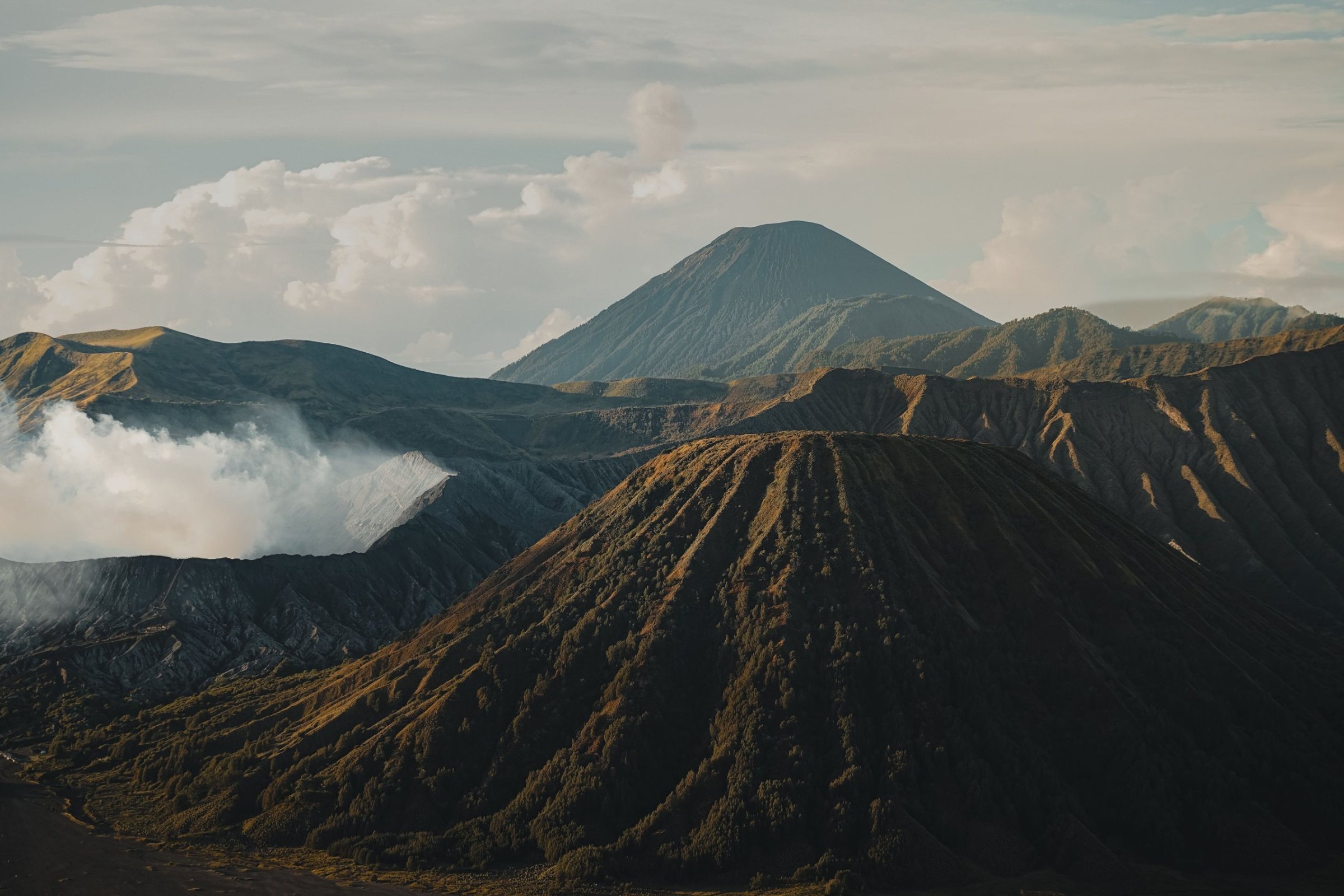
Bromo is the youngest cone inside the vast Tengger caldera, rising from a plain of volcanic sand. Sacred to the Tengger people and one of Java's most active volcanoes, it draws travellers for dawn views across the caldera.
A caldera within a caldera
Bromo rises from the floor of the Tengger caldera, a basin 16 kilometres wide at the northern end of a volcanic massif that extends south towards Semeru. The Smithsonian's Global Volcanism Program dates the complex to about 820,000 years and describes five overlapping stratovolcanoes, each cut by a caldera. At 2,329 metres, Bromo is not the massif's highest point, but it is the most active and the most visited.
The south-western Sandsea caldera, roughly 9 by 10 kilometres, holds the plain known locally as Lautan Pasir, the Sea of Sand. A cluster of cones grew on its floor within the last several thousand years, and Bromo is the youngest. Beside it stands the ribbed cone of Batok, often mistaken for Bromo. On clear mornings Semeru, Java's highest volcano, smokes on the southern horizon.
A restless history
Bromo erupts often, usually with ash and explosions rather than lava. On 8 June 2004 a sudden phreatic explosion sent ash about three kilometres high and killed two tourists. Late in 2010 activity reached the highest alert level, tourist areas closed and Malang's airport shut for days. Ash fell heavily around the crater into 2011, when one plume rose to about seven kilometres.
Ash emissions returned in late 2015, prompting a Level III alert, and continued through 2016, again disrupting flights at Malang and keeping visitors off the caldera floor. Further ash eruptions followed in 2019, with near-daily plumes in April, and briefly in late 2020. Since then the volcano has mostly released gas and steam, with renewed unrest in 2023.
The Tengger and Yadnya Kasada
The Tengger, a Hindu community whose villages ring the caldera, regard Bromo as sacred; its name is commonly traced to Brahma. Their temple, Pura Luhur Poten, stands on the Sea of Sand at the volcano's foot. Each year, on the 14th day of the month of Kasada in their calendar, they hold Yadnya Kasada. Ceremonies begin in the evening at Ngadisari, and at midnight offerings are carried to the temple for prayers.
Before dawn the procession climbs to the rim and casts vegetables, fruit, flowers, livestock and money into the crater, while some villagers clamber down to catch them for luck. The ritual recalls Roro Anteng and Joko Seger, a childless couple granted children on condition that one be given to the volcano. The park usually closes to tourists around the ceremony, so check dates before travelling.
Visiting
Most visitors come for dawn. The classic viewpoint is Penanjakan, on the outer caldera rim at a little over 2,700 metres, where Bromo, Batok and Semeru line up. Jeeps leave around 3 a.m. to reach it, and Seruni Point offers a quieter alternative. The usual base is Cemoro Lawang on the northern rim, reached from Probolinggo; other routes climb from Pasuruan via Tosari and from Malang via Tumpang.
From Cemoro Lawang it is roughly 45 minutes on foot across the sand to Bromo, or by jeep or hired horse. About 250 steps climb the final cone to a rim above a crater some 800 metres across. Nights are cold, and fog often hides the view in the rainy season, so the dry season offers the best chance of a clear sunrise. Entry arrangements and fees change, so check before you go.
Safety
Bromo is monitored by Indonesia's volcanology agency, PVMBG, which issues alert levels from I to IV. At Level II, where Bromo often stands, people have been barred from within one kilometre of the active crater; higher levels bring wider zones, which reached three kilometres in 2010. The steps to the rim have also closed during periods of frequent eruptions.
Explosions can come with little warning, as the fatal explosion of 2004 showed. Before travelling, check the current status on MAGMA Indonesia (magma.esdm.go.id), follow park staff and local guides, and never enter a closed zone, however calm the crater looks. Ash and fine sand are constant on the caldera floor, so carry a scarf or mask and wear sturdy shoes.
