North Sulawesi gives you two completely different kinds of diving within two hours of the same airport. On one side, Bunaken's coral walls drop into the deep blue. On the other, the black sand of the Lembeh Strait hides some of the strangest creatures in the ocean.
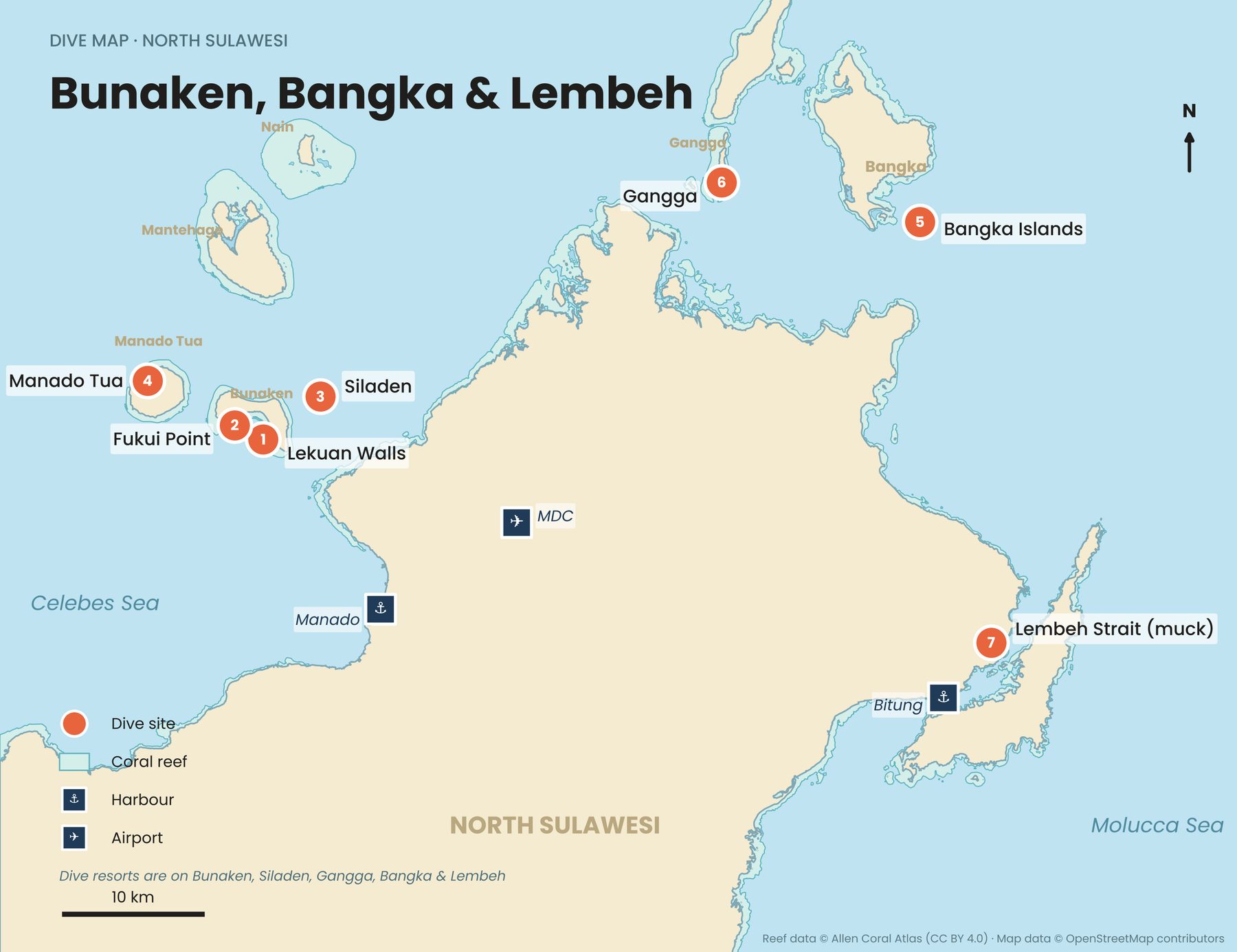
Bunaken National Park: the walls
Just off Manado, Bunaken National Park protects five islands and their reefs. The famous dives are walls that start a few metres below the surface and drop far beyond recreational depth. Turtles are everywhere.
- Lekuan WallsA series of walls on Bunaken's south side, with overhangs, cracks and lots of turtles. The classic Bunaken dive.
- Fukui PointA sloping reef and wall on Bunaken's west side, often with big fish and good coral.
- SiladenA small island with resorts, a pretty wall and easy diving close to shore.
- Manado TuaThe cone of an old volcano rising out of the sea, with walls around its shores.
Bangka and Gangga: soft corals and pinnacles
- Bangka IslandsAt the northern tip of Sulawesi. Pinnacles covered in colourful soft corals, often with current and big schools of fish.
- GanggaQuiet island with resorts and a mix of reef and muck diving, a good base between Bunaken and Lembeh.
The Lembeh Strait: the capital of muck diving
- Lembeh StraitA channel between the mainland and Lembeh Island, near the port of Bitung. The bottom is dark volcanic sand and rubble, and that's the point. Photographers come from around the world for mimic octopus, hairy frogfish, flamboyant cuttlefish, pygmy seahorses and many other small creatures that are hard to find elsewhere.
Muck diving means slow dives close to the sand, looking for small animals. Good buoyancy is essential. Don't touch or kick up the bottom, and let your guide point things out.
Practical information
- Getting there: fly to Manado (MDC). Bunaken is a short boat ride from Manado. Lembeh is about an hour and a half by road to Bitung, then a short boat ride.
- Combine both: many divers split their trip, a few days at Bunaken or Bangka for walls and reefs, then a few days in Lembeh for critters.
- When to go: diving is possible all year. Windier months can make the crossing to Bunaken rougher.
- Park fee: Bunaken National Park charges an entry fee for divers and snorkellers.
Frequently asked questions
Bunaken or Lembeh?
Bunaken for coral walls, turtles and blue water. Lembeh for macro photography and unusual creatures. If you have a week, do both.
Is North Sulawesi good for beginners?
Yes. Bunaken's walls usually have mild currents, and Lembeh's dives are shallow and slow. Just work on your buoyancy before muck diving.
Sources
- Reef data: Allen Coral Atlas, CC BY 4.0
- Map data © OpenStreetMap contributors, ODbL