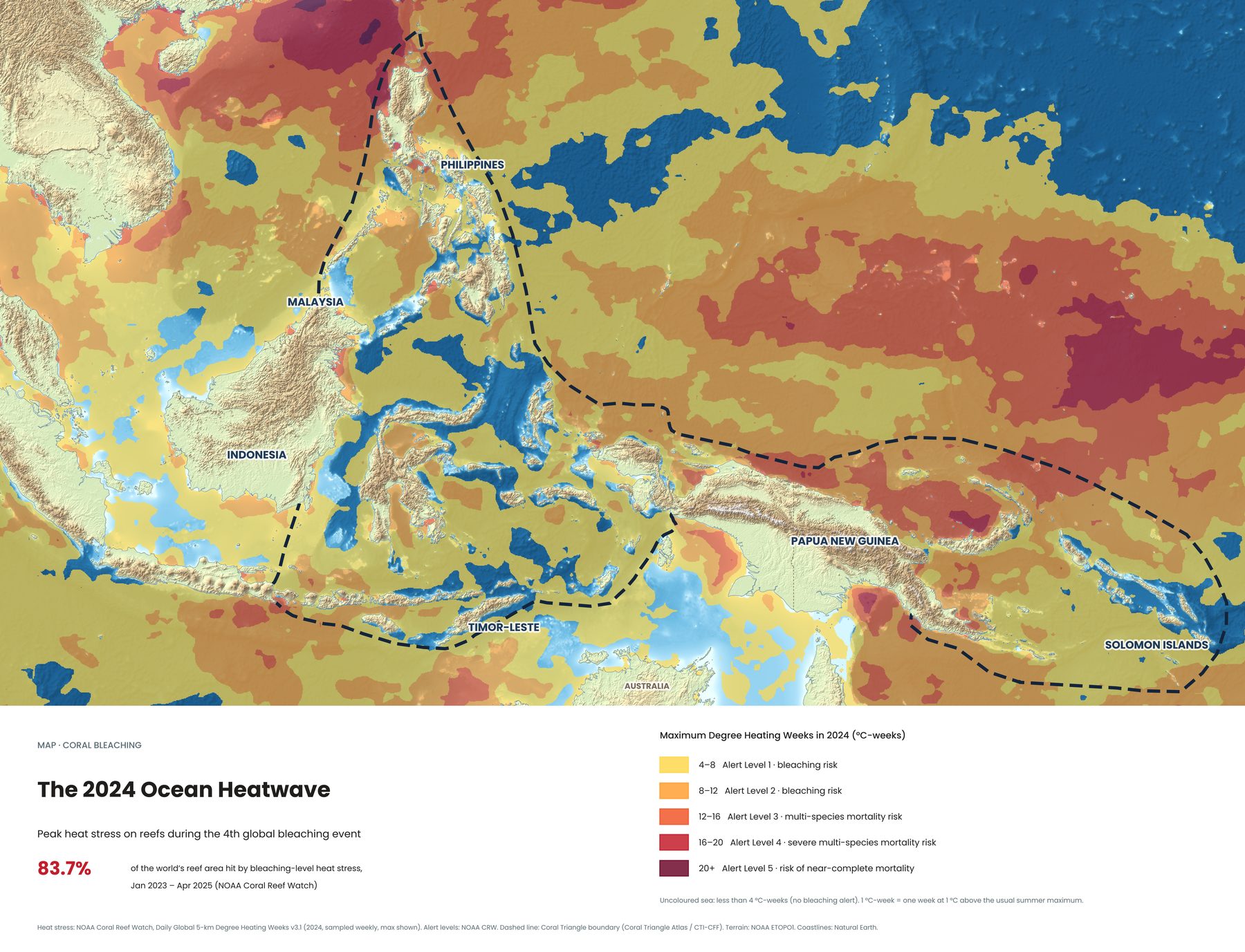
Between January 2023 and April 2025, bleaching-level heat stress reached 83.7% of the world's coral reef area, according to NOAA Coral Reef Watch. It was the fourth global bleaching event on record. This map shows how 2024 played out across the Coral Triangle.
What is coral bleaching?
Reef-building corals live together with tiny algae inside their tissue. The algae make food from sunlight and give corals most of their colour. When the water stays too warm for too long, that partnership breaks down. Corals expel the algae and turn white.
A bleached coral isn't dead yet. If temperatures drop in time, the algae can return and the coral recovers. If the heat lasts, corals starve and die, and the reef can take years or decades to come back.
How to read the map
Scientists measure heat stress in Degree Heating Weeks (DHW). One DHW means one week at 1°C above the usual summer maximum for that place. The more weeks and the hotter it gets, the higher the number. NOAA turns these values into alert levels:
| 4–8 DHW | Alert Level 1: bleaching risk |
|---|---|
| 8–12 DHW | Alert Level 2: bleaching risk |
| 12–16 DHW | Alert Level 3: risk of mortality across many coral species |
| 16–20 DHW | Alert Level 4: risk of severe mortality across many species |
| 20+ DHW | Alert Level 5: risk of near-complete mortality |
Uncoloured sea on the map had less than 4 DHW in 2024, meaning no bleaching alert.
What happened in 2024
Much of the open Pacific east of the Philippines and north of Papua New Guinea turned orange and red. Parts of the South China Sea reached the highest alert levels. Inside Indonesia, the picture was mixed: many reefs in the central and eastern seas stayed below the alert threshold that year, while others saw moderate heat stress.
Heat stress isn't the same as damage. How a reef actually responds depends on its corals, local conditions and what it has been through before. Monitoring on the ground is what tells the full story.
What divers and travellers can do
- Don't touch, stand on or kick corals, especially when they're stressed. Good buoyancy matters most after a heatwave.
- Use reef-safe sun protection, or cover up with a rash guard.
- Pay park fees and choose responsible operators. Protected reefs with less local pressure tend to recover better.
- Report what you see. Many dive centres and research groups collect bleaching observations from divers.
See all eight Coral Triangle maps →
Sources
- NOAA Coral Reef Watch: Daily Global 5-km Degree Heating Weeks v3.1, alert levels, and the fourth global bleaching event (January 2023 – April 2025)
- Boundary: Coral Triangle Atlas / CTI-CFF. Terrain: NOAA ETOPO1. Coastlines: Natural Earth